
Decaf Coffee for Acid Reflux — Does It Actually Help?
Coffee and Acid Reflux — A Common

If you have looked at decaf coffee labels, you have probably seen the words “Swiss Water Process” and assumed it means chemical-free. That assumption is mostly correct — but the full story is more interesting than the label suggests. Understanding how Swiss Water Process actually works helps you appreciate why it produces better-tasting decaf than cheaper alternatives, and why it genuinely does avoid synthetic chemical solvents.
Caffeine is a naturally occurring compound in coffee beans, and it does not simply rinse away with water. To remove it selectively — without stripping the flavour compounds that make coffee worth drinking — you need either a chemical solvent that binds specifically to caffeine, or a process that uses water and physics to do the same job without synthetic chemicals.
Most commercial decaffeination uses solvents like methylene chloride or ethyl acetate. These are effective, and residue levels in finished coffee are regulated to be extremely low. But for people who prefer to avoid synthetic chemical processing, Swiss Water Process offers an alternative approach that has been certified organic since its commercial launch.
Swiss Water Process uses a liquid called Green Coffee Extract (GCE) to remove caffeine from unroasted (green) coffee beans. Here is what happens step by step:
The process uses water and activated charcoal — both natural substances — and no synthetic chemical solvents at any point. That is why it can legitimately claim to be chemical-free in the sense that matters: no added synthetic chemicals come into contact with the coffee.
This is the honest part: yes, decaffeination always affects flavour to some degree. Any process that removes caffeine also removes or alters some flavour compounds — the chemistry is unavoidable. The question is how much, and how noticeable it is.
Swiss Water Process is considered one of the better-tasting decaffeination methods because the Green Coffee Extract saturation step limits flavour loss. Independent cup quality assessments consistently rank Swiss Water Process decaf above solvent-processed decaf at the same origin and roast level. High-quality specialty roasters use it for this reason.
The flavour difference between Swiss Water Process decaf and fully caffeinated coffee is real but not dramatic, especially when the underlying green coffee is high quality. A well-sourced, well-roasted Swiss Water Process decaf will taste far better than a poorly sourced caffeinated coffee.
Swiss Water Process is a registered certification. Roasters who use it are licensed to display the Swiss Water logo on their packaging. If you see this logo, the decaffeination was performed by the Swiss Water Decaffeinated Coffee Company facility in Canada under certified organic conditions.
If packaging just says “water process” or “naturally decaffeinated” without the Swiss Water certification mark, it may be a different (and possibly inferior) water-based method. The certification is the only guarantee of the specific process described above.
Swiss Water Process decaf is genuinely chemical-free in the sense most people care about: it uses no synthetic solvents. The process is certified organic, relies on water and activated charcoal, and produces decaf that tastes better than most solvent-processed alternatives. The 99.9% caffeine removal rate is also among the most thorough available.
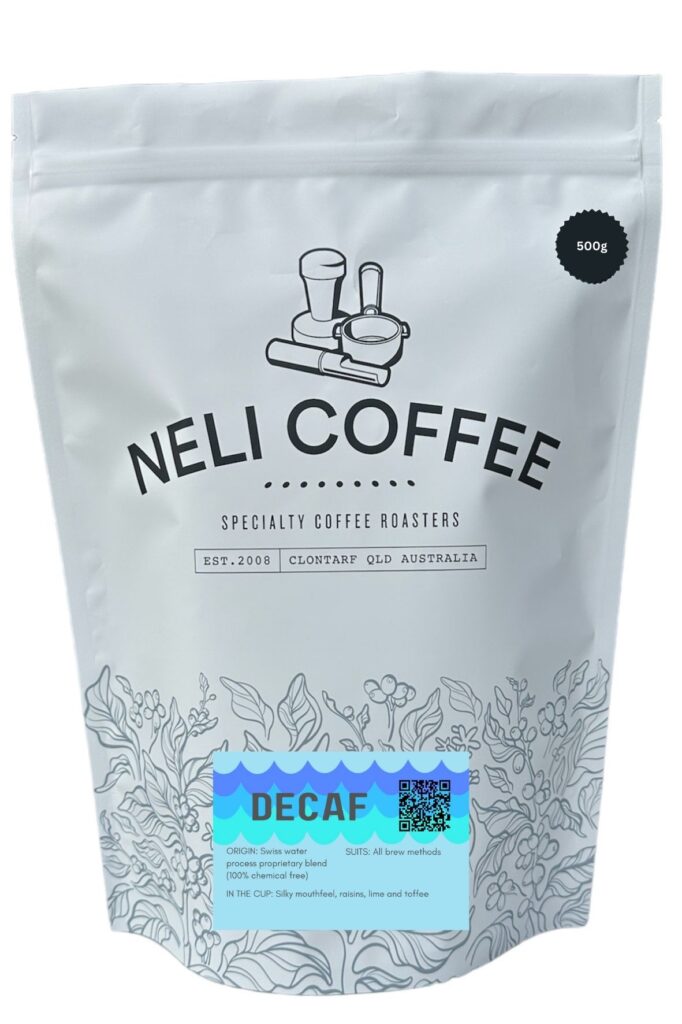
If you are reducing caffeine for health reasons, prefer organic-certified products, or simply want the best-tasting decaf option, Swiss Water Process is the right choice. Neli Coffee stocks Swiss Water Process decaf beans — browse our decaf range to find the right origin for your taste preferences.
Coffee and Acid Reflux — A Common
Why Green Coffee Storage Matters Green coffee
Two Different Drinks, Often Confused Walk into
Why Cold Brew Coffee? Cold brew coffee